Book Review: 1177BC by Eric Cline
- Christian Farrell
- Feb 9, 2025
- 5 min read
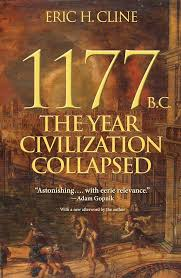
Welcome to the first book in the Triptych of Ancient Civilizations, Eric Cline's 1177BC.
Wait, don't leave!
Look, I love exploring ancient civilizations - my absolute favorite is fifth century Greece, but I love finding out more about everything that led up to it and then everything that followed up to the fall of the Roman empire. Since my knowledge of the pre-dark age Mediterranean was kind of fuzzy, I felt like this would be the perfect book for me.
About the title - from the 1300s onward, considered the end of the Bronze Age, you had several civilizations at their respective peaks. Egypt was still the big player in the Mediterranean, but the Hittites, Assyrians, Babylonians, and others were still going strong in Mesopotamia. In Greece you still had a bit of a Minoan presence, but the strongest player was the Mycenean Empire. Even tiny Cyprus - which had an extraordinary amount of tin (used to make bronze) - was a big player. These civilizations communicated with each other, warred with each other, and most importantly traded with each other, forming the first instance of "global" trade.
Then, right around 1177BC, most of those civilizations died out.
If you're wondering why this piqued my interest so much, let me take you back around 30 years (good gracious time flies) to Williamsburg VA. I'm taking an Epic Poetry class and absolutely loving it (caveat that I turned in my term paper two days late and probably got a C in the class since I was too lazy to do much of the work, but I still loved what we were learning!). This is where I was introduced to Norse poetry through Njal's Saga and was able to make sense of the Odyssey for the first time. But what really burst through was my love for The Iliad. I can definitively say that without taking this class there would be no way I would have been able to make sense of, much less appreciate, what I consider to be the greatest pro wrestling storyline ever created (they even cut promos on each other!).
The interesting thing about the Trojan War is that it happened around the 12th century BC, when the Myceneans were the rulers of Greece; however, when the story of The Iliad was "written" (actually spoken, but that's another story), the Dorians were the ones weaving the tale together. Because the Dorians did not know much about Mycenean culture, much less what people were like several centuries before them, they had to make do with what they had. For instance, The Iliad features several scenes of warriors riding into battle on chariots, as the Dorians knew the Myceneans did. However, since the Dorians did not know how chariots actually worked, in the story the warriors would then hop off the chariots before facing each other on foot.
One of the other facts that always stuck with me about this class had to do with vocabulary. At the time of the Trojan War, the name for the king/supreme leader was wotan, and the word for more "regional" kings underneath him was basileus. Then we enter the first recorded (or lack thereof) dark age and come back to Dorian-dominated Greece, where there is now only one word for king: basileus. Kind of makes you wonder what happened to all those wotans. (Also, if you noticed that wotan kind of sounds like the Norse Wodin, one of the spellings of Odin, remember that the Scandinavians actually started in modern-day Iran before migrating through Europe to the north - there's a reason the Norse gods bear a great resemblance to the Greek pantheon!)
Anyway, we should start actually reviewing this book. The book opens by exploring the civilizations at the height of the Bronze Age. While it could sometimes be hard to keep the "countries" straight (much less the various kings), there was a lot of interesting stuff to learn here. For example, paper was a long way from being invented, much less papyrus (I can hear Dame Judy Dench talking about taxes), so to communicate with each other, kings had messages baked into clay tablets (which makes sense when you think about how God handed down the Ten Commandments to Moses in the Old Testament). And most of the messages that we have been able to dig up and read were actually the ones that had been discarded and were later baked when the various cities were set on fire (um, spoilers!). There was also interesting stuff like finding out there is no archeological record of the Israelites taking over Canaan by force, and that not only did the aforementioned Trojan War actually happen, but we actually discovered messages written to Aleksandu (Alexander from The Iliad, more commonly known as Paris).
Then, around 1177BC, give or take a few decades, the Mediterranean civilizations basically collapsed. What caused all this?
Here's a spoiler: We don't know.

Kind of disappointing ending, right? But it's the truth - we don't really know exactly what caused the multiple collapses, or the timeline of events. We know that there were invasions AND internal revolts AND drought/famine AND uncontrollable ecological events (the sun's output waning for a few centuries, plus about 150 years of "earthquake storms", but things I never knew existed that are a bit frightening). The most likely thing is that ALL of this played into the collapse, and since, as mentioned before, this was the first "global" economy, when one civilization rolled over it shook the next one, which knocked over the next one, and on and on until none were left standing for centuries.
A little more nightmare fuel: This book was first written and published during the Covid pandemic, and I read the second edition, which included a few additions. One of the additions in the afterword noted that the author was interviewed on NPR after the book first came out and asked if something like this could happen today, where we have a true global economy. The answer of course is yes - for my take, if, for example, China's economy was suddenly exposed for the sham it is (but that's another another story!), it would drag down the economies of most countries in the world. So then the interviewer asked, with that being said, are there any lessons we can learn from this book that can be applied to today's world. And Eric Cline's answer was...no. Since we don't know exactly what happened or how it happened, there's nothing we can take from it, other than to know that it's inevitable for today's society (again, scary).
As you can tell from the length of this review, this is a subject that I find fascinating, so everyone's mileage will vary. In trying to put on my Objective Reviewer hat, I'll give this book eight out of ten hot dogs. It was very thorough, but as mentioned before it could be hard to keep things straight and the lack of a definitive wrap-up could really rub readers the wrong way. Nevertheless, I thoroughly enjoyed it, and look forward to soon reviewing the next book in the triptych...After 1177BC.


Comments