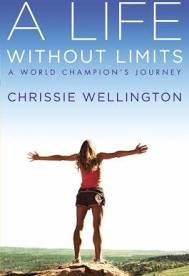
Book Review: A Life Without Limits by Chrissie Wellington
- Christian Farrell
- Dec 22, 2020
- 5 min read
I was on the wrestling team in high school. I was one of the worst wrestlers on one of the worst teams in our county, but that didn’t change the fact that I was a wrestler. I had to be strong, I had to be quick, I had to be intuitive, I had to be ready to pounce at all times.
My school didn’t have a football team, but we had great soccer and basketball teams. If you weren’t involved in athletics, those are the teams you would bring up in conversations with students from other high schools. But those who were on the soccer and basketball teams gave a ton of respect to us wrestlers – no matter how terrible our team was in competition, the other athletes knew how tough we were, how intimidating our practices were, and how hard we had to push ourselves.
Quick – name the men’s decathlon champion from the last Olympics? You’d think earning the title “World’s Greatest Athlete” would make you a household name, but despite how hard decathletes have to push themselves nobody has thought about them since Dan and Dave – and neither of them even won!
Can you name the Women’s 5,000 Meters champion? Or the Men’s Hammer Throw champion?
How about the Women’s Triathlon champion?
Now, bringing this up isn’t saying that any of these champions DESERVE our praise – it’s problematic to say anyone in any sport deserves anything for what they do on the field besides how they’re already compensated. But it is saying that if you’re a fan of NASCAR drivers (like me) or quarterbacks (like me) or baseball players (uh…pass), it’s interesting to keep in mind that there are athletes who put in ten times the practice effort for events that are 100x more difficult than mainstream sports, and only enjoy cult followings.
Which brings us to Chrissie Wellington. Chrissie was born and raised in Norfolk, England. She was a good student, a bit awkward socially (at least in her telling), and an above average swimmer. She eventually enrolled in Birmingham University (England), then spent the next few years travelling around the world before returning to England.
In high school, Chrissie experienced body-image issues that laddered up to bulimia. She struggled with bulimia for many years before overcoming the disease. She also turned vegetarian during her world travels (after being in a country where there killed the animal you ordered right in front of you!), but to an unhealthy degree – she eventually needed an intervention from her family due to her extreme weight loss. At this point, it’s hard to believe she was destined to become one of the world’s best athletes.
Upon returning to England, Chrissie was able to find a job in her country’s environmental department (as she noted, this was the pre-Iraq Tony Blair government, so it still seemed like a good idea!). She worked with them as they were preparing to host a UN summit on sustainable development. She quickly rose through the ranks and worked her way up to representing the UK at important meetings. She enjoyed working to help the less fortunate, but had an epiphany at a meeting in South Korea. There, at a summit on a resort with a man-made volcano, she realized that schmoozing with the rich and powerful wasn’t really doing anything for the world’s poor. She left her job, travelled the world once again, and found a position with a local charity in Nepal helping provide basic needs in a war-torn country.
Remember how this is the biography of one of the world’s greatest athletes? How’s that looking so far?
During all this time, Chrissie had been trying to stay in shape. She ran with a passion, swum when she could, and bought or borrowed cheap bikes to ride in places like the Andes and the Himalayas. She entered races like the Brooklyn Marathon and a run/bike/kayak race in Australia and found herself doing quite well. Back in England, another member of her running club suggested that she look into triathlons. After seeing some early amateur success, Chrissie decided to make a go at a full-time career.
While trying to find a coach who would be a fit for her and also be willing to take her on, she found Brett Sutton, a controversial coach who put her through physical and mental anguish. Through the rest of the book, Chrissie seems to have developed Stockholm syndrome with Brett – she had a ton of problems with him and the way he treated her, yet continued to seek his approval even after he was no longer her coach. By bringing Brett on as her coach Chrissie had to agree to stop thinking and let Brett make all of her decisions. While this was a difficult ask for Chrissie – not to mention an unusual thing for anyone to agree to – it did pay many dividends. One of those dividends was when Brett decided to move Chrissie from Olympic-length triathlons – where Chrissie very likely would have made the UK Olympic team – and instead have her focus on Ironman-length races.
After tons of grueling workouts, Chrissie rewarded that thinking by being the surprise winner of the Ironman Championship in Kona on her first try. To prove that it wasn’t a fluke, she then won it the next year. And the year after that. In fact, as of the writing of the book (it was published in 2012), she had won all thirteen Ironman-length races she had entered.
It was extraordinary to learn about how difficult the practices are as a professional triathlete – especially when Brett was in charge, and would make decisions like making someone run a marathon on the treadmill in a windowless closet. That’s not to mention the races themselves, in which Chrissie had to push herself at a top level for around nine hours. And, just like they mention in the NFL games around December, keep in mind that she wasn’t always in perfect condition when she raced – she was often suffering from some form of injury, and in her thirteenth triathlon was barely recovered from a horrific bike crash and was racing with at least one open wound on her body.
And if that’s not enough, Chrissie is very open about the lower points of racing, including a memory of the time she had to take a poop in the bushes on a live race broadcast, as well as a treatise on using urination as a defense mechanism when another racer gets too close to her bike.
Through the highs and lows, after reading this book it’s amazing that triathletes are barely known athletes. And that includes me – truth be told, I couldn’t answer the questions I posed in the beginning of this review, and when I bought this book I didn’t even know what sport Chrissie competed in. But after reading this book, I’m in awe of Chrissie and what she was able to accomplish – both in triathlon as well as in the rest of her life – as well as the triathletes that are still competing today (or at least when the virus is gone).
Very inspiring read – eight out of ten hot dogs!


Comments