Book Review: Alexander at the End of the World by Rachel Kousser
- Christian Farrell
- Apr 2, 2025
- 3 min read
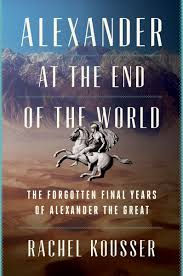
There's so much to this book I'm kind of stumped on where to begin.
Let's start with it as a book (which I should really try to do more of in my reviews anyway). This is a fantastic telling of a long and confusing story based on ancient sources where seven different writers say seven different things. Kousser does a fantastic job of getting inside not only Alexander's head - which is fascinating itself - but also the heads of his battle-weary troops who have been marching through strange lands for years and just want to go home. She also spends time going through the heads of key groups besides the army itself - notably the "war wives" and children of the army (including Alexander). This makes for a deeply felt moment towards the end of the book, when the soldiers are finally allowed to go home to Greece and Macedonia - but the women and children they've accumulated over the last ten years have to stay in Persia.
Only thing I would have liked better is if there was a map at the beginning of each chapter (mostly a Nook problem - if I was reading a paper book I could have flipped back-and-forth easily between the chapters and the map section, so I can't give points off for that. In total, giving this nine out of ten hot dogs!
Now, let's talk about Alexander. What he was able to accomplish was simply astounding, not only in terms of the lands that he conquered, but also in terms of keeping an army together for 10 years marching from Europe all the way into India. There was a ton of plate-spinning Alexander had to do to make that happen, especially considering the history of Macedonian royal assassinations (with Alexander potentially having a role in his own father's assassination). He had to keep his army focused and determined, despite the lack of food or shelter, despite the constant fighting, despite the unknown lands they found themselves in.
One of the ways Alexander kept his army motivated was by fighting at the front. He never sat back on a hill and watched the action - he was always in the thick of it himself, motivating the rest of his army to keep up with him. In one amazing story, his army was laying siege to a village in India. He could tell that the army was just going through the motions at this point, so Alexander took a siege ladder himself and began to climb the village walls. As soon as they saw that, his army ran to pick up more siege ladders to join him....so many did so that the ladders all broke, with Alexander hanging off the edge of the wall on his fingertips. His soldiers stood underneath him and told him to let go so they could catch him. Instead...Alexander scaled the rest of the wall and took on the Indians himself! He slew as many as he could while being barraged by arrows, finally collapsing when an arrow pierced his chest, with no idea when or if the rest of his army would be able to save him. They did make it over the wall shortly afterwards (mostly by standing on each other's shoulders!) and rescued him just in the nick of time.
Stories like that really show his courage. But they also show how bloody this story is. Alexander had three real goals: (1) conquer all the land he could; (2) reach the ends of the Earth; and (3) keep his army happy. Since that last goal tied so heavily into the other two, it became his primary focus. Sometimes Alexander could keep his army motivated through words and feasts. And sometimes he needed to find a defenseless village so his army could rape and plunder.
One of the things that really stuck out in this reading was Alexander's love life and sexuality. He had several wives, consistent with the Macedonian royal tradition. He also had relations with teenage boys (consistent with Greek tradition) and most likely with his best friend (who, based on Alexander's reaction to his death, may have been his true love). And, based on his adoption of Persian traditions, he also had eunuchs. Considering how much of Western military culture derives from Greco-Roman history, it's kind of amazing that this was the sexuality of the greatest Classical general who ever lived.
One other thing Kousser does well in this book is giving just enough insight to distinguish Alexander's inner circle - people like Ptolemy and Krateros. In fact, it's a shame that the book ends exactly when Alexander dies - while obviously this is a book about him, I would have loved to have heard about how his top generals divided up his empire while they were fresh characters in my mind.
Overall, this was an amazing book. Definitely recommend!



Comments