Book Review: Children of Ash and Elm by Neil Price
- Christian Farrell
- Nov 25, 2020
- 4 min read
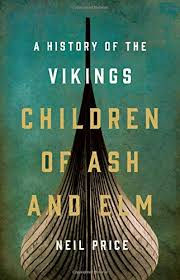
When you think about it, it’s kind of hard to write a history of the Vikings. Because who exactly are the Vikings? Was it just the people who raided other territories from the sea? Was it everyone who lived in Scandinavia? Did it also include the Scandinavians who lived in other countries, whether for trade or as conquerors?
In Children of Ash and Elm, Neil Price takes the broader view of the word, which does have some problems – not all Scandinavians lived up to the terror inherent in the word “Vikings” – but is no more problematic than any other interpretation.
The book starts with a section about the history of Scandinavian society, which was very intriguing. The most interesting part was about how what we would think of as “Scandinavians” turned into “Vikings”. Up through the fifth century AD, the Scandinavian communities were tribes just like the rest of non-Roman Europe. They traded, they fought, but nothing in particular distinguished them. Then there is a 150 year gap in the archeological record, and when our knowledge of them returns Scandinavian society has been re-settled around warlords.
What the book brings to light is that the reason for this was completely unknown by Scandinavians – it was due to two or maybe even three of the largest volcanic eruptions in modern history. While these eruptions happened across the globe and nowhere near Scandinavia, the ash and debris in the air clouded the northern skies like a nuclear winter. The safest bet for the Scandinavians for generations was to migrate south; among those that didn’t, tens of thousands died. As food and resources became scarce, tribal feuds became more pronounced and violent. In order to keep fed – and protected – the Scandinavians who remained pledged themselves to the fiercest fighters with the strongest armies. When the ash clouds had cleared, the Vikings were who remained.
As a modern history book, this section includes chapters on Viking gender roles as well as sexuality. This seems superfluous on the surface, since this was a male-dominated society that claimed to have punished male effeminacy with death. But a closer look at the archeological record shows women within prominent burial mounds surrounded by weapons, as well as men buried in traditional women’s clothing. These chapters do show that there were exceptions to every rule, and redefined gender/sexual roles were accepted even within this strictly conservative society.
After setting the table with what Viking society was like, the next sections of the book are more about their history. The first reports of proper Viking raids happened in the eighth century. An important note of distinction is that the raids happened both in the west (modern-day England, France) as well as the east (modern-day Germany, Russia). There are a couple of important points to keep in mind – not only that the raids in the west hit extremely wealthy but sparsely defended monasteries, but also that the raiders knew where to hit them because they had already been trading with the nation-states they raided. The early Vikings come off less as hardened warriors and more as cowardly opportunists stabbing partners in the back.
Not only is the “what” of Viking raids interesting, but also the “why” and the “how”. As Scandinavian society rebuilt itself after the nuclear winter-type mess and the area became more and more populous, it became harder and harder for men to become property owners and heads of families in good standing. Much of that had to do with family life: in Scandinavian society, men could have – and were expected to have – up to three wives at a time, while women were limited to one husband at a time. Not only were there less women available to up-and-coming men, but also men had to pay a dowry to the family of the bride-to-be. With less women available and much greater competition for their respective hands, raids offered the opportunity to (1) earn glory overseas, as well as much-needed ca$h; or (2) steal a bride from a foreign land. With those societal pressures, raiding became a part of everyday life.
As the raids went on, they became less about quick snatch-and-grabs and more about conquests of territory. Vikings set up a permanent presence in England – with the eventual Battle of Hastings in 1066 being fought between the armies of two Scandinavians – as well as France (with Normandy being granted to the Northmen), and in settlements in the east they formed a group called the Rus, who later mixed with the native Slavs to become the Russians.
Besides forming settlements near established Eurasian nation-states, the Vikings also colonized Iceland, Greenland, and, for a time, North America (although the settlement in Vinland did not last long). The settlement of Iceland, and what we know of it, was especially fascinating to me, since I’m also a fan of the Icelandic epics. The epic stories tell somewhat factual tales of generational feuds between families, over the years resulting in tens to hundreds of deaths. The tales are usually set between the 9th and 11th centuries, when Iceland was a democracy, were written in the 14th century, when due to troubles Iceland was applying to become part of Norway. According to the book, the reason these tales were written when they were was because of the very feuds they were covering. Although the epics included happy endings, the deaths were what was important – the writers, who were looking to be subjects of the Norwegian king, were exploring the limits, drawbacks, and victims of democracy.
Keep in mind this is just the tip of the iceberg – there’s a ton more in this book, including the impact of having no major Viking cities as well as how pagan Scandinavia converted to Christianity. The book is very long, but never felt like it was sagging – it is expertly written and continually fascinating. Very highly recommended – eight out of ten hot dogs!


Comments