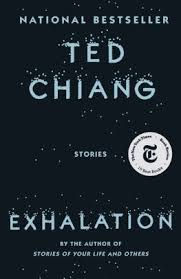
Book Review: Exhalation by Ted Chiang
- Christian Farrell
- Aug 16, 2020
- 2 min read
Ted Chiang’s first short story collection, Story of Your Life and Other Stories, is top to bottom packed with amazing science fiction stories. I feel like you have to modify the term “science fiction” here – “Story of Your Life” (which became the movie Arrival) involves aliens, but is really about how written and oral language can be different from each other (and have been in some cultures). “Tower of Babylon” and “Hell is the Absence of God” were both mind-bending stories based on the Bible. Overall, every story in Chiang’s first collection was at least great (retro review: ten out of ten hot dogs – go read it now!).
Chiang’s second collection, Exhalation, does not have the same top-to-bottom greatness as his first collection. One story, “The Great Silence”, barely connects (although in the “Story Notes” section Chiang mentions that the words were originally part of an art exhibit, and he thought they could stand alone as a short story). “Dacey’s Patent Automatic Nanny” has a great premise (a Victorian-era robot nanny and the impact it had on the children it took care of) but does not fully deliver. The longest story in the book, “The Lifecycle of Software Objects”, definitely drags at times – in the course of the story it brings up some very interesting situations, then blows right past them.
While I led with the negative, make no mistake about it – if Chiang’s first story collection is ten out of ten hot dogs, Exhalation is nine out of ten hot dogs.
If there’s a theme to this collection, it’s free will. The most potent story on this theme is also one of the shortest, “What’s Expected of Us”, which asks what would happen to the human race if a simple children’s toy could prove there’s no such thing as free will? The last story, “Anxiety is the Dizziness of Freedom”, uses the ability to access multiple alternate timelines to explore what decisions are actually based on free will vs. being intrinsic to who you are. The first story, “The Merchant and the Alchemist’s Gate”, employs a portal that allows people to travel back in time, but with the guarantee that absolutely nothing you do in the past will change anything in the future.
Speaking of “The Merchant and the Alchemist’s Gate”, Chiang also includes religious themes – in that story, the religion is Islam, with the story taking place in the Middle East of a few centuries ago (“Baghdad, the city of peace!” is an ironic recurring line). The story most similar to the ones from Chiang’s first collection is “Omphalos”, in a similar but very religious world which is then proven to not be the center of God’s attention.
Just like “Story of Your Life”, “The Truth of Fact, the Truth of Fiction” deals with language. There are two different tales told in this story – one where picture-perfect memory is made available to a future society, and one where written language is introduced to an ancient culture – and wrestles with the question of whether there is a difference between what is true and what is correct.
While this doesn’t completely measure up to Chiang’s first story collection, this is an amazing book by a brilliant author – very highly recommended!


Comments