Book Review: For God and Country by James Yee
- Christian Farrell
- Jul 14, 2020
- 4 min read
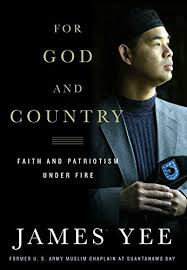
James Yee’s For God and Country is a very difficult story to read. Yee is a West Point graduate who served overseas in the 90s and became an Army chaplain at Guantanamo during the War on Terror, asked to attend to both personnel as well as prisoners. Therein lies the rub: Yee is a Muslim, who converted shortly after graduating West Point and re-entered the Army as one of the first Muslim chaplains. The Army brass thought it would be a good idea to have a chaplain to work with the prisoners; unfortunately, the base command thought it would be an even better idea to arrest Yee and several other Muslim servicemen and charge them with treason.
Yee is a second-generation American who grew up in Jersey (represent!) mostly thinking about baseball. His high school wrestling coach (double represent!) got him interested in West Point, and as tough as it was he persevered and graduated. While he grew up a casual Christian, a conversation he had shortly after graduation made him curious about Islam; after doing some research, he decided that this was the religious path he wanted to follow. After serving a tour in the Army, Yee retired to study Islam full-time, enrolling in a Syrian religious school to learn more.
Yee later re-joined active service through a program supporting the first Muslim chaplains. Yee eventually found himself stationed at Guantanamo. While ostensibly to attend to the servicemen (and there were a few Muslims at the base), he was also asked to attend to the religious needs of the prisoners. This is where the book really becomes fascinating – Yee’s story conjures so many recollections of that time period and how shockingly bad the “terrorist” prisoners (many of whom were guilty only of being Muslim) were handled.
In theory, Yee’s availability to the prisoners was just one of the religious courtesies afforded to the prisoners. Not only was he available to them, but also the prisoners were provided Qurans and had arrows pointing towards Mecca. In practice, the only reason these religious courtesies were extended were so they could be stomped on. Qurans, which must be kept in a clean space, were routinely thrown on the ground or in a toilet bucket, to the extent that the prisoners pleaded with officials to take their Qurans away – but the request was denied so the guards could continue to mishandle them. At times the directions to Mecca were taken away, or the guards would engage with the prisoners during times of prayer (or play loud heavy metal). During interrogations, prisoners were routinely degraded by either being made to strip down or being in the room with female officers who would strip down. Yee himself was also used as a chess piece, often being prohibited from talking to certain prisoners or needing to be accompanied by a guard. Yee learned about this treatment while attending to the prisoners; his closeness to them would have dire consequences.
As stated earlier, Yee also came to believe (as was later proven true) that most of these prisoners had no connection with terror groups – many were just in the wrong place at the wrong time and held in cages for years on end. Yee describes the heat in the prison, the squat conditions, the ever-present smell of dirty men – it’s insane to think how many people were locked up there for years for no real reason (other than Bush-era officers being too chickensh*t to admit a mistake). One memorable passage was about three children who were flown over from Afghanistan and put into a “premium” cell, premium only in that it had a slit in the wall that looked out onto the ocean. However, the children were there for no discernable reason (“that’s classified”), and there for so long that the national media started harping on it.
One of Yee’s biggest concerns was to make sure the rest of the Army understood that Islam was not the cause of terrorism, that the terrorists were bad Muslims acting against a religion of peace. In that, Yee started a program where he would lead a class on understanding Islam for servicemen just arriving at Guantanamo. However, that well-intentioned program (as well as his service to the prisoners and fights with brass for better treatment), instead made him seem suspicious to the wrong people.
Shortly before leaving Guantanamo for a leave, Yee had heard about some of his fellow Muslim service members being imprisoned and brought up on unbelievable charges upon returning to the states. Yee himself left Guantanamo, and was immediately arrested upon arriving in Jacksonville. Thinking this was just a misunderstanding, Yee was hoping his detainment would result in a ride to the airport; instead, he was transported to a secret prison in South Carolina, where he was held for months without a court appearance. He was confined to a cell similar to the cages in Guantanamo, was denied access to the exercise yard for weeks at a time (and had to be strapped in arm and leg irons), and was denied communication with anyone outside of his lawyer.
He was initially jailed for espionage and conspiracy charges; however, unknown to Yee, as the months went by the Army was unable to find a way to make the charges stick. As a way to buy time (again, they were too chickensh*t to admit they just made a mistake), they continued to tell the court that they were still forming their defense – and the court continued to accept their decision. Eventually, though, over the months that Yee was sitting in a secret military prison, the charges against him were dropped one by one, until they were reduced to a few misdemeanors (that he still was likely innocent of) that were decided out of court – but cost him his career.
It's amazing to think of all the things that went wrong during the Bush-era War on Terror. This is just one horrible tale, but it brings to mind so many mistakes and misjudgments that you would hope we have learned from. Recommended read – seven out of ten hot dogs.



Comments