Book Review: His Truth Is Marching On
- Christian Farrell
- Jan 18, 2021
- 3 min read
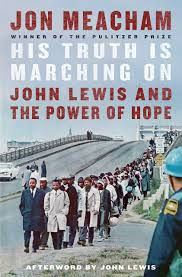
One of the most incredible parts of moving to Atlanta, for me, was the fact that John Lewis was my Congressional Representative. The “Representative” part of that title was what really inspired me – being “represented” by such a giant made me want to work harder to be worthy of that representation. I know if felt that way to a lot of other Atlanta residents as well, and after his passing this past summer there were numerous billboards and posters reminding us to exercise our right to vote, and not be afraid of a little “good trouble”. It is both ironic and unfortunate that his passing helped us elect a Democratic presidential ticket as well as two Democratic Senators.
Jon Meacham’s His Truth Is Marching On follows Lewis’s life from childhood to 1968, when he left the Student Non-Violent Coordinating Committee. The through-line in this period is his devotion to Christianity. In a time where Christianity always seems to be utilized to support right-wing values, it is fascinating to watch someone use Christianity to work towards actual liberty and freedom. Just like Martin Luther King, Lewis believed in working towards the “Beloved Community”, where all people were equal and free. The protests he joined, and the forms of protest he took, all had to dovetail with the Beloved Community.
In order to work towards the Beloved Community, his protests had to be non-violent, and he always had to find love for the people he was protesting against, even when they were yelling at him, spitting on him, or battering him with a police baton. Lewis was jailed hundreds of times and sustained numerous injuries while fighting for justice – it is amazing to read about all the punishment that he withstood without ever hitting back.
Lewis’s nonviolent protests made him a legend in the Civil Rights movement in his early twenties. He quickly rose up the ranks of the SNCC and became their leader. He organized and participated in the famous (and deadly) Freedom Rides, and sat in the Oval Office across from both Kennedy and Johnson. One of his most famous moments was joining the protest march from Selma to Birmingham. Lewis was severely beaten crossing the Edmund Pettis Bridge, but continued the march, broken bones and all, being ferried to a makeshift hospital every night.
Lewis’s adherence to non-violent methods was like a boulder in a river; eventually, though, the river changed direction. While images of the police beating nonviolent protesters shocked mainstream America into pushing for Civil Rights in 1963, but 1968 it was a whole new country. Martin Luther King was assassinated, Robert Kennedy was assassinated, and young men were being drafted and shipped to Vietnam. While the march from Selma to Birmingham was a historic moment in the Civil Rights movement, it was also one of the planks the SNCC used to pry him from the leading the organization. He soon left the SNCC, with its new leader Stokely Carmichael, future “honorary Prime Minister” of the Black Panther Party.
The world had changed, but Lewis kept his devotion to the Beloved Community. He was not perfect, as this book illustrates, but he did more good than most other people living today. It was a pleasure to have learned more about his life, and an honor to have been represented by him. Nine out of ten hot dogs.


Comments