Book Review: London Fields by Martin Amis
- Christian Farrell
- Mar 6, 2020
- 4 min read
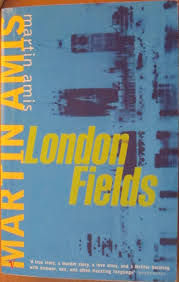
I started reading London Fields because it was recommended in an article on The Ringer. I’m familiar with some of Martin Amis’ short stories (and have loved what I read), but have never tackled a novel. After finishing this book, the results are…mixed.
The reason this was recommended in the Ringer article is that although this novel was written in the 80s, it sounds even more prescient today. The story revolves around a poor small-time London criminal named Keith who is devoting his life to women and darts (“Darts innit!”) in order to get on TV, a milquetoast upper class waste of space named Guy, and the seductress named Nicola who plays them off of each other. (Sidebar: Her full name is Nicola Six, and is sometimes referred to as Nikky. Is that a Motley Crue Easter egg? Did one influence the other?) The first reason this novel is such a reflection of our time is that these are easy stand-ins for Brexit voters, with Keith the stand-in for the uneducated and vaguely racist Brxiteers (“Heritage!”), Guy the out-of-touch Remainer, and Nicola kind of person who doesn’t even bother to have an opinion.
The second reason this is a reflection of our times is that as the story transpires, the environment is collapsing in the background. The sky is falling, the sun seems too close, and it all leads up to an eclipse on November 5th (Horror Day) with dangerous consequences.
So undoubtedly this is a meaningful book for this period of time. But is it enjoyable? Well…somewhat. The main characters are fine – pretty well developed, although each with attributes that park right next to the absurd. But each of these characters have several other characters orbiting around them, such as fellow regulars at the Black Cross Pub (Shakespeare, Zbig One, Zbig Two, F*cker), Keith and Guy’s respective families, Keith’s side pieces, etc. There are a LOT of characters in this book. At one point at the end, a revelation is made about a character called Richard…and I have no memory of a character named Richard being in the book (which may actually be a joke by Amis).
Not only are there a lot of characters, there are also a lot of actions (as opposed to story) in this book. There are a ton of things going on, but I can’t really tell how much of it was actually necessary to the story – it feels like it could have been condensed by half. Keeping in mind that the story is given away right at the beginning – even before the main characters meet, the book gives away that Nicola is going to be murdered, and tells you that Keith will be the murderer. Yes, there are twists and turns to get to what that ending becomes, but I can’t say that most of them actually move the plot forward.
Also, bear with me here: There is a narrator in this book. The narrator is the author of the book. The author is not named Martin Amis. The narrator is staying in London in the apartment of another author (with the initials MA) and is freely interacting with the other characters. Which he admits in the beginning he created, as it is his novel. Sound confusing? I thought it would make more sense as the novel kept going, but halfway through the book when the narrator is talking to Nicola about her thoughts on her upcoming murder it still feels awkward.
The story concludes on Horror Day, as the world seems to collapse on the same day Nicola’s murder is to happen (and, also, Keith’s darts championship). It was well set up (but seemingly more by the previous 30 pages than the first 300) and well executed. There is a late twist that does make some sense but is not 100% earned, but the ending is definitely the highlight of the book.
One other note: This is a book from the 80s. There is some racist language that I think represented Keith’s way of thinking but wasn’t well distinguished from the author’s. Nicola straddles the line between riot grrl and Bowie’s “China Girl” and can be problematic at times. Reading about some of Keith’s harem of women can be troubling, and there are issues of child and spousal abuse that come up in the second half of the book that don’t seem to get as much attention from the characters (or narrator) as they should. In essence, it was a different time, and if you can’t look past that, there’s no reason to proceed.
I can’t say that this was a BAD book – the main characters were well done, there were many funny moments, it’s a perfect encapsulation of our time (just written 40 years ago), and the ending mostly works. If it seems like I’m being too negative about the novel, it’s more disappointment. I took a writing class at the New School about 20 years ago, and after reading one of my short stories one of my classmates said I reminded her of Martin Amis. After reading his collection of short stories I was elated. Now, after reading his most impactful novel, I guess I expected more of myself. Five out of ten hot dogs.


Comments