Book Review: Still Alive by Forrest Galante
- Christian Farrell
- Aug 11, 2021
- 5 min read
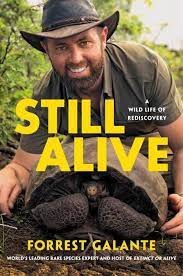
I only know Forrest Galante from Shark Week - in my opinion his shows have stolen the past three editions (you can still catch "Mystery of the Black Demon Shark" if you hurry). His three contributions focus on finding new species of sharks, rather than exposing celebrities to sharks (not that that's a bad thing), and I'd never seen him mix and match with the other shark specialists. After this year's episode I did a search and found out he recently wrote a memoir, so that's how we got here!
The thing about Forrest, and this is evident in all three of his Shark Week specials, is that he really straddles the line between enthusiastic expert and self-righteous millennial @sshat, and his book is no different. Forrest grew up in Zimbabwe on his mother's plantation. He was always fascinated by the surrounding wildlife, especially snakes, and kept many animals in his house. He reports being neighborly with all of the workers on the plantation, and was best friends with their kids. It's unclear if he ever felt the disparity between his life and the lives of the workers' families - if he did, he never mentioned it in the book.
In the 90s Zimbabwe passed land reformation laws allowing native Zimbabweans to overtake European plantations. Forrest doesn't mention any nuance to this in his book - he speaks only of the fear of his family being held at gunpoint or arrested. To his point, this did happen to some of his relatives, and his estranged father (who Forrest doesn't elaborate on) was apparently a key figure in the government and actively looking to jail his mother.
Arriving in America, Forrest's family settled in California, where he learned about the animals living in a completely different ecosystem. His love for animals being the only thing propelling him through school, he graduated from college with a degree in biology and started a career in entry-level conservation - mainly donned a radiation suit to spray weed-killer in protected areas.
It wasn't a degree and a job that boosted Forrest to millennial conservation heights; it was his entry into the show "Naked and Afraid", where he used his survival skills and knowledge of nature to be one of the most successful contestants of all time - so much so that, according to the book, the producers had to unsuccessfully ask him to seem more helpless and worried to make compelling television.
When Forrest returned to California, he received his requisite 15 minutes of fame, with newspaper (remember them?) and website reporters calling him to ask them about his experience. Forrest refused to talk about the show, but would tell them that what he DID want to talk about was the snake population in the desert, or the impact of climate change on sea life. He says that most of the reporters hung up, but a few hung around and took in the story (after all, content is king!). A few stories sparked a few more stories, then a few more stories. Forrest used the nascent power of YouTube to record short videos of things like diving with hammerheads or swimming with crocodiles to further express his love of nature. Through these means, he started to become well-known in the conservation field.
Through this fame, Forrest was in a position to launch a pilot for a TV series on Animal Planet. After consideration, he chose to make his show about "extinct" animals. "Extinct" is in quotes because, as Forrest explains in the book, animal populations being threatened/endangered is much different than animals choosing to stay as far away from humans as possible. Forrest recorded the pilot for "Extinct or Alive" and saw it popular enough to be turned into a long-running series. One of the hallmarks of the show, according to the book (note: I've never watched the series) is that they need to demonstrate why the chosen animals are important and how vital they are to their ecosystems - he ensures this, he says, because there's no way to ensure they can find a "lost" animal on a ten-day location shoot. In fact, in the first two seasons of "Extinct or Alive", they had only "found" three of the animals, but still made popular programming.
Forrest worked on "Extinct or Alive" and spread out into a couple of other projects, but let's focus on what brought him to the table (or, at least, my table) - Shark Week. When Forrest first talked to Discovery about a special, he said that unlike the other specials they ran, he wanted to show hard/actual science, he didn't want celebrity involvement, and instead of featuring large sharks he wanted to find a supposedly extinct Pondicherry shark, which only reach around 3 feet long. Forrest, his wife (also a biologist), and a Discovery crew headed to the Indian Ocean to find a specimen. Surprisingly, they did find one - local fishermen in Sri Lanka had caught one, and not knowing how valuable a find it was, traded it to Forrest's wife for a box of smokes. The specimen is now stuffed and in a museum.
For the next year's Shark Week special, Forrest decided to up the game and find THREE lost species of sharks. He - and this time, his own crew - headed to South Africa, and...they found all three (kinda - see below)! This special, "Extinct or Alive: Land of the Lost Sharks", was one of my favorite shark shows, and really highlighted how difficult it is to find these creatures.
The book doesn't get to "Mystery of the Black Demon Shark", but it does get into what he was doing right before COVID hit. He was asked by the Indonesian government to help find Tire Croc - a crocodile with a tire around its neck that was slowly choking it to death. Forrest and his crew were hunting for it for several days when they were suddenly told the country was about to be locked down. They just barely caught flights home and watched the shutdown envelope the rest of the world. Not one to sit still, Forrest earlier this year put together a series for VICE News exposing wet markets around the country, knowing that COVID most likely jumped from bat to human in a wet market in China.
One of the major criticisms of Forrest is that he claims credit for finding animals that he himself did not find. While Forrest does not confront this directly in his book, he is sure to mention when he is just associated with a discovery. For example, on a popular episode of "Extinct or Alive", some people have criticized him for claiming credit for re-discovering the Galapagos tortoise. In the book, Forrest only writes of being on the team that found the tortoise - he says that another team member called them over, then Forrest picked it up for the camera. He doesn't really claim credit for doing much single-handedly in the book, so the criticism may be overblown.
This was a pretty interesting book overall. I'll give it seven out of ten hot dogs.


Comments