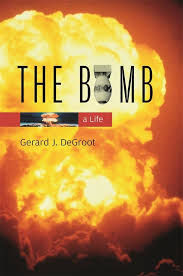
Book Review: The Bomb by Gerard J DeGroot
- Christian Farrell
- Aug 18, 2025
- 4 min read
Eighty years and a few days ago the US exploded two atomic bombs over Japan. Atomic bombs have not been used in war by any country since, yet the specter of nuclear warfare has been the invisible hand influencing foreign relations for the eight decades since.
Gerard J DeGroot's The Bomb follows the history of nuclear bombs from the discovery of radiation in the 19th century through the cleanup and isolation of testing sites in the first years of the 21st century. It is a thorough and comprehensive book, yet still gripping throughout.
With the US being the major player in nuclear weaponry, it helps that DeGroot is English, as he provides perspectives that Americans would be hard-pressed to come to. He discusses the second thoughts the other Allies had about America actually using nuclear weapons in Japan, especially on Nagasaki (which had no military value). He also discusses how Western European countries during the Cold War were very skeptical that the US would step in if the USSR launched a nuclear strike on them; growing up in the 80s I had assumed that would definitely happen, but our allies didn't fully trust us (which was part of the reason why England and France developed their own nuclear programs).
There was a ton to learn in this book - while DeGroot weaves it all together, the bits and pieces of learning really stick out. Here's some of the parts that fascinated me the most:
The pursuit of major explosives like atomic bombs was only made possible by the expansion of military strategy. Historically, military targets were limited to the other country's military. But with the expansion of technology after the Industrial Revolution, the presence of planes and bombs and tanks expanded the targeting to include factories and warehouses - the science drove the strategy. Eventually, as technology allowed for greater and greater destruction, military targets grew to include civilians as well - after all, civilians man the factories and cheer on the military. Despite that expansion, when President Truman announce the Hiroshima bombing to the country, he said it had targeted a military base and weapons factories - he either didn't understand or didn't want to understand that it had destroyed an entire city.
The Soviets did not have the scientists to pursue atomic weaponry during WWII - like Germany, the Soviets had declared physics "Jew science" before the war. However, the Soviets did use left-leaning scientists (not Oppenheimer) as spies in Los Alamos. The data gathered from those spies may or may not be the reason the USSR was able to develop their atomic weaponry relatively quickly after the war (there was friction between the scientific and espionage communities about who was most responsible for their first successful test). One thing that's for sure is that the US did not have any spies among the Soviet atomic scientists - right before the first Soviet test, the US believed the USSR was still a decade away.
Through the Truman, Eisenhower, and Kennedy administrations, if a nuclear war were to break out we would be the most likely "winner" - we had more nuclear weapons, and we had bombers and missiles stationed in Western Europe that could reach the USSR, while the Soviets could not reach America (so they likely would have taken out Western Europe instead). So for about two decades after WWII there were many high-level people in government, such as Curtis LeMay from the Air Force, who were adamant that we strike the Soviets first (even if the consequences would include 1-2 of our own cities being destroyed). Even during the Cuban Missile Crisis, which was the first time the Soviets had attempted to put the US in range, we likely could have wiped out the Soviet Union with a first strike.
To keep the population from freaking out, the US government really oversimplified how to protect yourself from nuclear fallout. Using communiques from figures such as Bert the Turtle ("Duck and cover, kids!"), the government mentioned that actions such as washing your hands and taking a shower would protect you from radiation poisoning. And that wasn't just a 50s thing - that was the line all the way through to the 80s. Also, the government encouraged people to build their own fallout shelters in the 50s instead of financing community shelters because they were afraid of looking like socialists.
While only two nuclear weapons have ever been used in wartime, hundreds of atomic and thermonuclear devices have been tested all over the world. While in the 40s and 50s it was thought that the radiation would solve itself in a few hours, we now know that some places in Nevada, Australia, Russia, and the like will need to be uninhabited for the next few centuries (even though we tried to move Pacific Islanders back to Bikini Atoll as late as the 90s). And the radiation doesn't go away - it gets into the air and circles the earth. Nobody reading (or writing) this post has ever experienced a nuclear test; yet all of us at one point or another has had radiation from a nuclear test pass through us, and many of us know someone who died as a result of that radiation. Even if no more nuclear explosions ever happen, existing fallout will be a concern for more than a thousand years.
Speaking of testing, it probably wouldn't surprise you to learn that the Soviets tested nuclear fallout on their own people. I might surprise you to learn that the Americans and British did the exact same thing during the 40s and 50s and had soldiers march through just-used testing zones to study the impact of radiation on the human body. While scientists then didn't know as much as we know now about radiation sickness, they definitely knew it would poison the body (the soldiers, on the other hand, knew nothing about it). It also might surprise you to learn that both western countries had lawsuits about these test tied up in courts for years and years in the hope that claimants would die before the cases could proceed.
As you can see, there is A LOT going on in this book. It is informative, fascinating, and very frightening. Tremendous piece of writing - nine out of ten hot dogs.


Comments