Review: Alone on the Wall (Plus Bonus: Free Solo)
- Christian Farrell
- Aug 19, 2019
- 7 min read
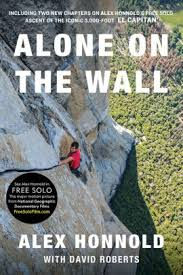
Some things are just hard to visualize. I can read a book about astronomy and read about the vast distances between objects, but I can’t visualize it. I can read a book about physics and read about the behaviors of sub-atomic particles, but I can’t visualize it.
The reason for this lack of visualization is because I don’t have a basis of comparison. If something tall was described as, say, “three Empire State buildings stacked together”, I can make a picture of that in my head. But saying a mountain or rock wall is 2,000 feet tall – that’s a lot of feet, but I can’t really see what that looks like.
That’s one of the problems I had with Alex Honnold’s Alone on the Wall. The other is that, without knowing mountaineering/rock climbing lingo, it’s hard to figure out what’s being discussed. Yes, there’s a section at the beginning where they explain some of the terms that will be used; however, over the course of the book, if you forget what terms like “beta” and “pro” mean (like I did), you’ll be lost.
I have a feeling both of these problems could have been alleviated by reading this as an actual book instead of in Kindle form. If I were able to read this as an actual book, I could put a bookmark on the page where the terms are explained and refer back to it (note: I’m sure there’s a way to do this in Kindle form too, but it’s not intuitive). Also, I saw him signing books (more later), and noticed that the printed books had at least two sections worth of picture breaks, which would really help with the storytelling.
While both of those problems may have been helped with a physical book, the main problem would not – the choppy storytelling. The book is really divided into two sections. The first section switches between Alex’s words and the words of writer David Roberts. Both write chapters, with David telling the more objective story and Alex offering his thoughts, impressions, and insights. David’s sections are in regular text, while Alex’s sections are in italics (which gets annoying while reading full chapters).
This first section is the original version of the book. However, since the book’s publication Alex famously free soloed El Capitan. Instead of writing a separate book about this climb, Alex just added several more chapters to this book. For whatever reason David Roberts did not contribute to this part of the story, so the second half is 100% Alex’s words, which makes an awkward transition in the storytelling.
The fact that these problems exist is a shame, because you can tell how incredible the story is, even if like me you have problems contextualizing it. Free soloing (which means climbing with no assistance and no equipment, and without touching any manmade equipment already in the rock) is very dangerous, which we are reminded of during the book as some of the pioneers of the sport die during attempts. Alex, however, is drawn to the adventure of it, and proves to be a prodigy. While he made his name early on in Yosemite, he joined expeditions all over the world, and ends with his famous climb of El Capitan.
While there is plenty of drama in the climbing, a couple of other things really stood out. The first is Alex’s commitment to poverty and the environment. After an expedition to North Africa, Alex decides to form a foundation, using his sponsorship money and increasing income, to find eco-friendly ways to help the less fortunate. He puts his money where his mouth is too – literally – by swearing off red meat. As the story goes on, he also begins to re-think the importance of some of his expedition invites by considering the environmental impact of his air travel.
For someone with his own foundation and lots of sponsorship money, the second point that stood out was really surprising: for most of his adult life, he lived in his van. And he loved it. As he wrote, even when he bought his first place in Las Vegas, he still slept in the driveway and only used the house for the wifi – until he found out the wifi extended to his driveway, when he briefly resumed living in his van.
The third thing was the impact his high-risk lifestyle had on his social life. Alex made it clear that, while he felt lonely sometimes, he would never let someone come between him and his climbing. While he had brief relationships here and there, he never seemed to have a real relationship until he met his girlfriend Sanni, who he meets in the second half of the book (he met her on the book tour for the original version of the book). The relationship gets off to a rocky start, literally – on one of their early dates, Sanni (who is not an experienced climber) was belaying Alex when she made a mistake with the rope and Alex fell off the mountain and fractured his hip. While he was thinking of ending the relationship right there, Sanni convinced him that his life would not get better just by letting her go. He found it within him to forgive her, and their relationship continued growing through the end of the book.
These are great stories, bracketed by intense rock-climbing adventures. However, as noted, these adventures are hard to picture for the unexperienced, and written in a choppy format. Because of this, I cannot fully recommend this book – I give it 5 out of 10 hot dogs.
But I didn’t want it to end there – since my biggest problem with the book was visualization, I found the movie Free Solo on demand and watched that to complete the experience.
Free Solo is the filming of Alex’s free solo of El Capitan, so it aligns with the second half of the book. It was also filmed “live” (some of Alex’s previous movies were recreations of free solos he had done on his own).
There was a lot to unpack here. The first was Alex himself. He is extremely articulate and bright. He is also extremely emotionally distant. He doesn’t seem to understand the value of other people, nor how the danger of what he does impacts other people’s feelings. It really wouldn’t surprise me if he had a processing disorder.
Intrinsic with that is his relationship with Sanni. It is obvious from the film how much Sanni loves Alex, and how she’s trying to open him up to emotions he doesn’t feel comfortable expressing. It is also clear how their relationship can be a little dysfunctional. Notably, Sanni, who it is made clear has very little climbing experience, is often shown belaying Alex on roped attempts (including when he fell and sprained his ankle before his first El Capitan attempt), or climbing tethered to him. Which doesn’t seem very helpful for a professional climber training for a historic summit (although I’m sure Alex knows better than me!). Also notable was Sanni’s presence in Alex’s van prior to his first (failed) summit attempt, where she keeps engaging him in conversation when he seems to want to be alone with his thoughts, and reminds him of the danger.
As had been written in the book, there was a good amount of “filler” filmed after Alex sprained his ankle, but it comes off beautifully in the film, including Alex getting a CAT scan to see why he is the way he is (turns out he has an under-active amygdala), and Alex buying his Las Vegas home (while Sanni is measuring the rooms for furniture, Alex opens the bedroom door, looks down, and tells the camera “I can sleep right there on the rug”).
Also illuminating was how exactly Alex failed his first attempt. As noted above, a “free solo” means you do a climb alone, carry no equipment, and touch nothing man-made on the mountain. From the book you know that while Alex did climb El Capitan on his first attempt, and did do it solo, he did it by grabbing pinions hammered into the wall for rope climbing, nulling the attempt. I had wondered how this would translate in the movie, but it was indeed very obvious – Alex is filmed, in the dark illuminated only by a headlamp, climbing the wall, then says “This sucks…I hate this…I want this to be over” and grabs the pinion, after which we cut to all the film crew radioing each other that Alex bailed on the attempt.
While the failed attempt is deflating, it is made much more understandable in the film how daunting a task his free solo really is. For one thing, it is very apparent just how large this rock wall is. One of my favorite visuals was something that I don’t think the filmmakers intended but just worked wonders on me – there’s a shot where Alex and Sanni are diving their van down a Yosemite highway, with the camera crew shooting in the back in the seats behind them. As Alex is driving you can see through the windshield that it’s a cloudy day. As they drive on, though, you can see that it wasn’t cloudy at all – that was just El Capitan filling the entire windshield.
The other thing the film makes clearer is what climbing entails. In the book Alex talks often about what kind of moves he needs to make going up the wall – to him, the climb is really the memorization and expression of thousands of practiced moves. What makes it sing, though, is to see the millimeter protrusion of rock that he has to set his right foot upon, or the fissure he has to stick his fist into for support while hanging thousands of feet in the air. Words on a page can’t express how difficult this is – it really has to be seen to be believed.
Counter to most content, in my mind the film is actually better than the book – Free Solo gets 8 out of 10 hot dogs.


Comments