Roanoke Raiders and Powder Boy of the Monitor by Gordon D. Shirreffs
- Christian Farrell
- Jun 10, 2023
- 3 min read
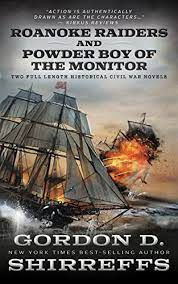
Yes, second nautical-themed book in a row! Actually, two books - Roanoke Raiders and Powder Boy of the Monitor are two separate (short) novels.
If you read my last book review, for The Wager, you might remember how I mentioned that I appreciated how many nautical terms were explained for the layman. These books, though, have whole paragraphs that make no sense to landlubbers like me. They do have plenty of explanations, though, often in forced exchanges like this:
"Wow, this ship is huge!"
"Actually, it's XX feet long and XX feet wide, and displaces XX cubic feet of water."
"I wonder what kind of weapons we have?"
"There are two fifteen-inch guns on the forward deck and two ten-inch guns aft."
So, you're getting that.
While I can't say these novels were all that entertaining, their adherence to actual events did teach me a bit about the naval part of the Civil War that I didn't know before. Both stories are told from the perspective of teenagers finding themselves involved in naval battles (oh brother), and both take place in 1862. What's strange about it, though, is the first story, Roanoke Raiders, is set in the latter portion of 1862, when ironclad ships were increasingly common on both sides. The story, however, follows a boy on a wooden Union ship that is part of a fleet being tasked with destroying a Confederate ironclad that was considered the ultimate blockade-buster. There were two things I learned reading this story. First, while I knew about the naval blockade, I didn't know that as early as 1862 (when McClellan was still in charge of the Union army) the Union also controlled many of the ports from Virginia down to North Carolina. Second, I never realized that in the Civil War most ships, even the wooden ones, had engines along with sails - which made it easier to sail when there was no wind, but also provided a distinct target for enemy fire.
Powder Boy of the Monitor follows, well, a powder boy on the Monitor. This one had a lot of historical nuggets I never knew before. I always imagined the battle between the Monitor and the Merrimack would have been a thrilling story. What this novel makes clear, though, is that it was actually pretty anti-climactic. It turns out the Monitor was developed by a Swedish engineer working with the Union. She was also barely sea-worthy and almost didn't make it to the battle at all. However, she was perfect for navigating rivers, which is where the battle took place. The Merrimack dwarfed the Monitor, and it was thought the battle would be a lost cause; however, it turned out that, while the battle was pretty much a draw, the Monitor actually had advantages in shallow water due to her speed and lower depth. The two ironclads battled to a draw, then the Merrimack retreated up the James River. Months later, the ship re-appeared...and blew itself up. The Monitor tried but failed to sail up the James River to Richmond. It was then ordered to sail to Charleston...and sunk trying to sail through Cape Hatteras. So, again, pretty anticlimactic.
I think the fact that I learned a good deal about Civil War naval battles has to be noted; however, I would rather have learned them through a non-fiction book where I wouldn't have had to follow wooden characters and stilted dialogue. There are better Civil War stories out there - five out of ten hot dogs for this collection.


Comments